Security breaches and compliance failures have evolved from IT incidents into existential business threats. Organizations face operational disruption, eroded customer trust, and regulatory penalties that can reach millions of dollars. As companies accelerate digital transformation and adopt cloud-native architectures, traditional security approaches struggle to keep pace with modern development velocity.
DevSecOps consulting addresses this challenge by embedding security and compliance directly into the software development lifecycle. Rather than treating security as a final checkpoint, this approach creates continuous protection throughout the development process, resulting in fewer vulnerabilities, stronger compliance posture, and faster, safer releases.
This article explores how DevSecOps consulting reduces security breaches and compliance risk, why internal efforts often fall short, and how to choose the right consulting partner to protect your business long-term.
What Is DevSecOps Consulting?
DevSecOps consulting integrates security and compliance into every stage of the software development lifecycle using automation, policy-as-code, and continuous monitoring. The goal is straightforward: reduce security breaches, ensure continuous compliance, and enable faster software delivery without slowing development teams.
Unlike simply adding more security tools, consultants focus on transforming how security is implemented across the organization.
Why Security Breaches Continue to Rise
Despite significant security investments, breaches continue across industries. The challenge isn’t a lack of technology; it’s how security is implemented.
Most organizations operate with fragmented security processes where development, operations, and security teams work in isolation. Security checks occur late in the release cycle, compliance is handled manually, and cloud environments frequently suffer from misconfigurations.
The root cause: security operates reactively instead of proactively.
When vulnerabilities are discovered post-deployment, or worse, following an attack, remediation costs multiply exponentially. According to IBM’s 2024 Cost of a Data Breach Report, the average cost of a breach reached $4.88 million, with detection and response taking an average of 204 days. Compliance gaps identified during audits result in delays, financial penalties, and long-term reputational damage.
Five Core Objectives of DevSecOps Consulting
1. Shift Security Left Into Development
Security is introduced early in the development process, allowing teams to identify and resolve vulnerabilities before code reaches production. This approach reduces the time and cost associated with late-stage security fixes.
2. Automate Security Testing and Compliance Checks
Security scans and compliance validations run automatically within CI/CD pipelines. Every release must meet defined security standards before deployment, eliminating reliance on manual reviews and reducing human error.
3. Reduce Human Error Through Policy-as-Code
Security and compliance rules are enforced programmatically, removing the risk of mistakes caused by manual configurations or inconsistent processes. Infrastructure and application policies are version-controlled and automatically applied.
4. Ensure Continuous Compliance
Instead of periodic audit preparation, compliance is monitored and validated in real time. This provides constant audit readiness and eliminates last-minute scrambles to demonstrate compliance.
5. Improve Security Without Slowing Delivery
Automated and integrated security controls enable teams to release software faster while maintaining robust protection. Security becomes an enabler rather than a bottleneck in the development process.
How DevSecOps Consulting Reduces Security Breaches
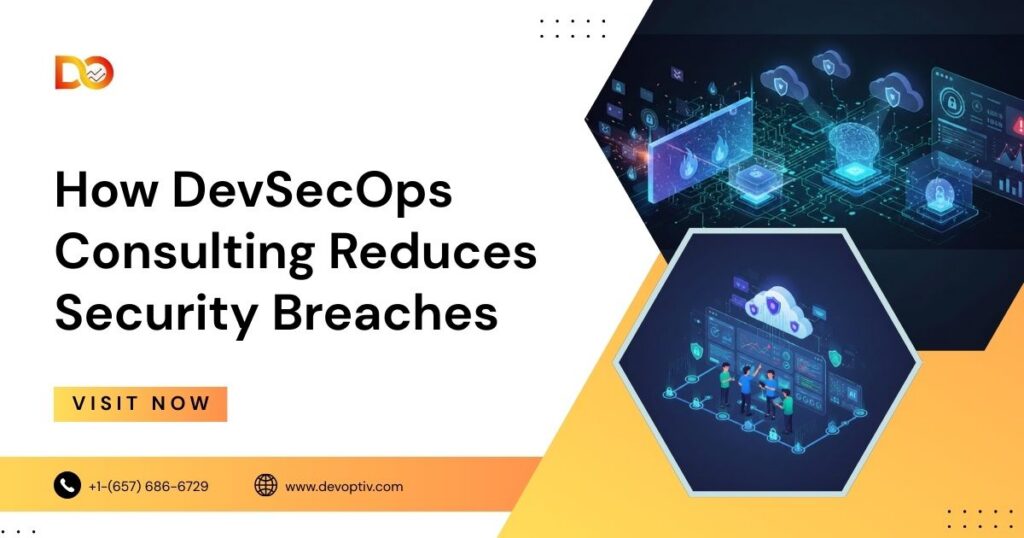
DevSecOps consulting embeds security into every stage of development, ensuring vulnerabilities are identified and fixed before they reach production. By enabling early detection, automated testing, and faster remediation, it significantly lowers the risk, cost, and impact of security breaches.
- Early Detection Through Shift-Left Security
One of the most effective breach prevention strategies involves catching vulnerabilities early, before they reach production environments. DevSecOps consultants integrate security practices during application design, code development, and build stages.
In a recent engagement with a fintech platform, we implemented shift-left security practices that identified 73% of critical vulnerabilities during the development phase, compared to just 12% previously caught during pre-production security reviews. This early detection reduced their mean time to remediation from 14 days to 6 hours.
- Continuous Automated Security Testing
Manual security reviews cannot keep pace with modern release cycles, which can involve dozens of deployments per day. DevSecOps consulting replaces inconsistent manual checks with automated, repeatable security testing embedded directly into CI/CD pipelines.
These automated checks continuously scan for code-level vulnerabilities, open-source dependency risks, container image vulnerabilities, and infrastructure configuration weaknesses. No release advances unless it meets defined security standards.
- Secure Cloud Infrastructure Configuration
Research from the Cloud Security Alliance indicates that 95% of cloud security failures result from customer misconfigurations, not cloud provider vulnerabilities. DevSecOps consulting focuses heavily on securing cloud infrastructure through least-privilege access controls, secure infrastructure-as-code templates, centralized secrets management, and continuous configuration monitoring.
For example, a healthcare SaaS company we worked with reduced their cloud security findings by 84% within 90 days by implementing infrastructure-as-code security policies that prevented risky configurations from ever being deployed.
- Real-Time Monitoring and Faster Threat Response
Security protection doesn’t end at deployment. DevSecOps consultants implement continuous monitoring and alerting to detect suspicious behavior early, enabling organizations to identify threats in real time, respond before damage escalates, and significantly reduce downtime and data loss.
How DevSecOps Consulting Reduces Compliance Risk
Compliance requirements including SOC 2, ISO 27001, PCI-DSS, HIPAA, and GDPR grow increasingly complex and strictly enforced. Manual compliance processes struggle to maintain pace with both regulatory changes and development velocity.
- Automated Compliance Through Policy-as-Code
Rather than relying on documentation and checklists, DevSecOps consultants convert compliance requirements into enforceable policies within development pipelines. Non-compliant changes fail automatically, controls are applied consistently across all environments, and audit evidence is generated continuously without manual intervention.
An enterprise software company preparing for SOC 2 Type II certification reduced their audit preparation time from 8 weeks to 3 days by implementing automated compliance controls that continuously validated security requirements.
- Continuous Compliance Monitoring
Traditional audits are disruptive because compliance is validated only at specific points in time. DevSecOps consulting enables continuous compliance monitoring, where controls are validated in real time and gaps are identified immediately. This approach drastically reduces audit preparation time, provides auditors with real-time evidence, and eliminates stressful last-minute remediation efforts.
- Eliminating Human Error in Regulatory Processes
Manual compliance processes depend heavily on individual knowledge and discipline, making them vulnerable to mistakes, especially under pressure. Automated compliance enforcement ensures controls are applied consistently across all environments without relying on human memory or manual intervention.
Why Internal DevSecOps Initiatives Often Struggle
Many organizations attempt to implement DevSecOps internally but encounter significant challenges:
• Lack of specialized security expertise in cloud-native and container security
• Tool sprawl without a coherent implementation strategy
• Cultural resistance from development teams viewing security as a hindrance
• No defined roadmap or clear ownership of the DevSecOps initiative
• Difficulty balancing security requirements with aggressive development timelines
DevSecOps consulting bridges these gaps by bringing proven experience, structured implementation frameworks, and scalable processes that internal teams can adopt with confidence.
Measurable Impact: Industry Research and Client Results
Organizations across SaaS, fintech, healthcare, and enterprise environments increasingly rely on DevSecOps consulting to manage complex cloud infrastructures and strict regulatory requirements.
According to the 2024 State of DevOps Report by Google Cloud and DORA, elite DevSecOps teams deploy 973 times more frequently than low performers while maintaining 6,570 times faster recovery from incidents. Organizations implementing DevSecOps practices report:
• 60-75% reduction in critical vulnerabilities reaching production
• 85% improvement in audit readiness and compliance posture
• 50% faster mean time to remediation for security issues
• 40% reduction in security-related deployment delays
Business Benefits Beyond Security and Compliance
While risk reduction is the primary objective, DevSecOps consulting delivers additional business value:
• Faster and more reliable releases enable rapid market response
• Lower incident response and audit preparation costs
• Increased customer trust through demonstrable security practices
• Stronger brand reputation and competitive differentiation
• Improved developer productivity and satisfaction
DevSecOps Consulting from Devoptiv
At Devoptiv, our DevSecOps consulting focuses on measurable outcomes rather than theoretical frameworks. We help organizations proactively prevent security breaches, maintain continuous compliance, and secure cloud-native and CI/CD environments without disrupting development velocity.
Our approach scales security alongside innovation, enabling teams to move faster with confidence. By aligning security directly with business goals, we transform protection into a strategic enabler, ensuring your organization stays secure, compliant, and competitive at every stage of growth.
Conclusion: Security as a Strategic Advantage
Security breaches and compliance failures carry significant costs, but they are not inevitable outcomes of digital transformation.
DevSecOps consulting reduces security breaches and compliance risk by embedding protection directly into how software is built, tested, and deployed. Organizations adopting this approach gain resilience, speed, and long-term customer trust without sacrificing innovation.
If your business is scaling cloud infrastructure, accelerating release velocity, or preparing for compliance audits, now is the time to act.
Ready to strengthen your security posture? Schedule a free security assessment to discover how DevSecOps consulting can protect your applications, simplify compliance, and accelerate growth.
FAQ’s :-
DevSecOps consulting integrates security into every stage of the development lifecycle. It helps teams automate security checks, reduce vulnerabilities early, and build secure applications faster.
By shifting security left, automating scans in CI/CD pipelines, and monitoring threats continuously, DevSecOps helps detect and fix risks before they reach production.
Yes. DevSecOps consulting scales with your business, improves security posture, and reduces costly breaches without slowing down development.
No. Automation and early security testing actually speed up releases by removing last-minute security issues and manual reviews.
Absolutely. It embeds compliance controls into workflows, ensuring continuous compliance with industry standards and regulatory requirements.