Discover how international SEO services help global businesses overcome geo-specific ranking challenges, capture multilingual traffic, and turn visitors from every corner of the world into paying customers
You have built a great product. Your website looks sharp. Your domestic traffic is growing steadily. But the moment you try to expand into international markets – Germany, Japan, Brazil, the UAE – your rankings flatline. You are invisible on Google.de, Yahoo! Japan, and every other regional search engine that your ideal customers actually use.
This is one of the most common and most costly growth blockers for businesses expanding globally. And it is almost always an SEO problem, not a product problem.
International SEO services exist precisely to solve this. They bridge the gap between your content and the search engines, languages, and cultural expectations of every market you want to reach. When done right, international SEO does not just improve your rankings, it fundamentally changes your global revenue trajectory.
This guide covers everything you need to know: what international SEO services actually include, why generic SEO fails globally, and the step-by-step strategies that deliver results in multiple markets simultaneously.
What Are International SEO Services?
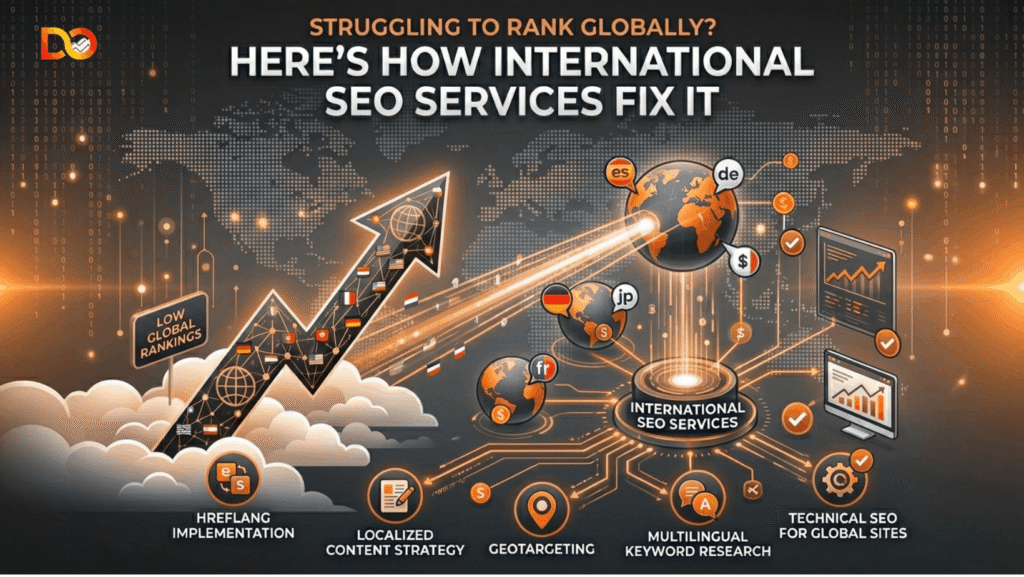
International SEO services are a specialised set of strategies and technical implementations designed to help websites rank in multiple countries and languages simultaneously. Unlike standard SEO, which optimises for a single market, international SEO accounts for regional search engine behaviour, language variations, cultural nuances, and geo-targeting signals.
A comprehensive international SEO service typically includes:
- Hreflang implementation: telling search engines which version of your content serves which country or language.
- Geo-targeting configuration: setting up country-specific signals in Google Search Console and server settings.
- Multilingual keyword research: identifying what your target audience actually searches for in each local language, not just translated keywords.
- Localised content creation: producing culturally relevant content that resonates with each market.
- International link building: earning backlinks from authoritative domains in each target country.
- Technical SEO audits: ensuring your site architecture supports multi-regional and multilingual delivery.
Without these elements working together, even the most well-funded global expansion can stall entirely in organic search.
Why Standard SEO Fails in Global Markets
Most businesses make the mistake of applying their domestic SEO strategy to international markets with minor adjustments. This approach consistently fails, and here is why.
1. Translated Keywords Are Not Localised Keywords
Translating your English keywords into French or Spanish gives you words not search intent. A French user searching for accounting software might use entirely different terminology than what a literal translation produces. Effective international SEO services conduct native keyword research in each target language, identifying actual search behaviour rather than linguistic approximations.
2. Google Does Not Automatically Know Which Market You Are Targeting
Without proper geo-targeting signals hreflang tags, country-specific domains or subdirectories, Google Search Console geo-targeting settings Google will serve your content inconsistently across markets. You might rank well in Australia while being completely absent in Canada, even if both markets speak English.
3. Local Competitors Have a Built-In Authority Advantage
A local German SaaS company targeting German buyers has years of local backlinks, local brand mentions, and localised content signals that you simply do not have on day one. International SEO services help you systematically close this authority gap through targeted link acquisition and content strategies in each market.
4. Technical Infrastructure Issues Multiply Internationally
Slow page load times caused by distant servers, hreflang errors affecting hundreds of URLs, duplicate content across language versions, these technical problems are manageable in one market and catastrophic in many. International SEO requires a robust technical foundation before any content strategy can work.
The Core Components of Effective International SEO Services
Here is how a specialist international SEO agency approaches a global expansion campaign:
| Component | What It Does |
|---|---|
| Hreflang Tags | Tells Google which language or region each page targets, preventing competition between different versions of the same content. |
| URL Structure | Determines whether to use ccTLDs (.de, .fr), subdomains (de.site.com), or subdirectories (/de/, /fr/) based on your international SEO strategy. |
| Multilingual Content | Develops culturally relevant content for each market instead of relying on direct translations. |
| Local Keyword Research | Finds native search terms with real search demand rather than using literal translations. |
| International Link Building | Builds backlinks from authoritative local websites to improve country-specific rankings. |
| Technical SEO Audit | Detects issues like crawl errors, slow page speed, and structural problems that impact global performance. |
| Search Console Geo-targeting | Sends location signals to search engines so the correct regional version appears for users in different countries. |
Step-by-Step: How International SEO Services Fix Global Ranking Problems
Step 1: International SEO Audit
Every successful international SEO engagement begins with a comprehensive audit. This covers your current geo-targeting setup, hreflang implementation (or lack of it), international crawl coverage, page speed across different regions, and existing rankings in target markets.
The audit reveals the exact gap between where you are and where you need to be — and prioritises fixes by impact. This prevents wasted effort on low-priority changes while critical technical issues remain unresolved.
Step 2: URL Structure Decision
One of the most consequential decisions in international SEO is how you structure your URLs. Each approach has clear trade-offs:
- Country-Code Top-Level Domains (ccTLDs) – e.g. yourbrand.de: Strongest geo-targeting signal, highest trust in local markets, but most expensive and complex to maintain. Best for large enterprises with dedicated local teams.
- Subdirectories – e.g. yourbrand.com/de/: Consolidates domain authority, easier to manage, and still effective for most businesses. Recommended for the majority of mid-market companies.
- Subdomains – e.g. de.yourbrand.com: Treated somewhat separately by Google, diluting authority benefits. Generally not recommended unless technical constraints force the choice.
International SEO services guide this decision based on your budget, technical infrastructure, and market priorities not a one-size-fits-all recommendation.
Step 3: Hreflang Implementation at Scale
Hreflang is the technical backbone of international SEO. It is a set of HTML attributes that tell search engines: ‘This page in German is the equivalent of this page in English.’ Without it, Google may serve the wrong language version to users, or worse, treat your language variants as duplicate content and filter them from results.
Proper hreflang implementation at scale across hundreds or thousands of URLs requires automation, rigorous QA, and ongoing monitoring. A single error in your hreflang code can negate months of content work.
Pro tip: Always include a self-referencing hreflang tag on every page, and an x-default tag for users in markets you have not yet specifically targeted.
Step 4: Native Multilingual Keyword Research
This is where most DIY international SEO fails. Translating your existing keyword list is not keyword research, it is a shortcut that consistently underperforms.
Effective international SEO services use native speakers and local market data to identify:
- How local users phrase their problems and search queries
- Regional terminology differences (British vs. American English, Castilian vs. Latin American Spanish)
- Local search volume and competition levels for each keyword
- Cultural context that affects search intent and content expectations
This research shapes everything downstream: your content structure, your page titles, your meta descriptions, and your internal linking architecture.
Step 5: Localised Content Creation and Optimisation
Content localisation goes far beyond translation. A localised page for the Japanese market does not just use Japanese words, it reflects Japanese search behaviour, addresses Japan-specific pain points, uses examples and case studies that resonate with Japanese buyers, and formats content according to local reading preferences.
International SEO services typically involve working with in-market content specialists who understand both SEO best practices and local cultural expectations. This combination is what separates content that ranks from content that simply exists.
Step 6: International Link Building
Backlinks remain one of Google’s strongest ranking signals but their value is geo-specific. A link from a high-authority German news site helps you rank in Germany. A link from a US technology publication does almost nothing for your German rankings.
International link building strategies include:
- Digital PR campaigns targeted at local media outlets in each market
- Partnerships with local industry associations and directories
- Guest contributions to regionally respected publications
- Local sponsorships and events that generate organic brand mentions
Building this link profile in multiple markets simultaneously requires significant resource investment which is why working with an experienced international SEO service provider is so valuable.
Step 7: Technical Performance for Global Audiences
A page that loads in 1.5 seconds for a user in New York may load in 6 seconds for a user in Mumbai and Google’s Core Web Vitals assessment reflects regional performance, not just your local experience. International SEO services address this through:
- Content Delivery Network (CDN) configuration – serving assets from servers close to each user’s location.
- Server location optimisation – hosting country-specific versions on regionally appropriate infrastructure.
- Image and asset compression – reducing page weight for markets with slower average connection speeds.
- Lazy loading and caching strategies – improving perceived performance on mobile devices across all regions.
International SEO vs. Local SEO: Understanding the Difference
These two terms are frequently confused, but they address very different challenges.
| Factor | International SEO | Local SEO |
|---|---|---|
| Target Audience | Multiple countries and languages | Single city or specific region |
| Primary Tools | Hreflang tags, ccTLDs, geo-targeting | Google Business Profile, local citations |
| Content Strategy | Multi-language, culturally localized content | Location-specific landing pages |
| Link Building | Country-specific backlinks from global domains | Local directories and citation-based links |
| Complexity | High – requires managing multiple markets and regions | Moderate – focused on a single geographic area |
Key Metrics to Track in International SEO
Measuring success across multiple markets requires a more sophisticated reporting framework than single-market SEO. Important metrics we can use to track may include:
- Organic visibility by country – how visible your site is in each target market’s search results.
- Market-specific keyword rankings – tracking primary and secondary keywords in each language independently.
- Hreflang error rate – monitored via Google Search Console’s International Targeting report.
- Organic traffic by country and language – segmented in Google Analytics to identify which markets are gaining traction.
- International organic conversion rate – not just traffic, but the percentage of international visitors taking desired actions.
- Crawl coverage by language version – ensuring Googlebot is discovering and indexing all localised pages.
A specialist international SEO service will build dashboards that track these metrics across all target markets simultaneously, giving you a clear picture of global organic performance rather than a confusing mix of aggregated data.
Common International SEO Mistakes That Kill Global Rankings
Even companies with strong domestic SEO performance regularly make these errors when expanding internationally:
- Using auto-translated content without native review – machine translation lacks the nuance needed to rank and convert in any language.
- Blocking language-specific URLs from crawling – a robots.txt misconfiguration can wipe entire market presences overnight.
- Implementing hreflang incorrectly – missing self-referencing tags, wrong language codes, or incomplete coverage all cause ranking failures.
- Launching all markets simultaneously without prioritisation – spreading SEO resources too thin across too many markets produces poor results everywhere.
- Ignoring local search engines – Baidu in China, Yandex in Russia, and Naver in South Korea require their own optimisation approaches.
- Neglecting mobile performance in emerging markets – where mobile is the primary (and often only) internet access device.
How to Select the Right International SEO Service Provider
Not every SEO agency has the capability or systems required to handle international SEO successfully. When comparing potential partners, focus on these key qualities:
- Proven case studies demonstrating rankings and traffic growth in multiple international markets
- Native-language capabilities in your target markets not just translation services
- Technical SEO depth, particularly around hreflang, URL architecture, and Core Web Vitals
- Experience with market-specific search engines beyond Google
- Transparent reporting across markets with clear attribution to business outcomes
- A phased approach strong international SEO providers prioritise markets strategically rather than launching everywhere at once
A word of caution: agencies that promise rapid international rankings through high-volume, low-quality content or link schemes will damage your global domain authority and potentially trigger manual penalties from Google. Quality and compliance always win over shortcuts in international search.
What Results Can You Realistically Expect?
International SEO is a long-term investment, not a quick win. Here is a realistic timeline for what a well-executed strategy delivers:
| Timeline | Expected Milestones |
| Months 1–2 | Technical audit completed, hreflang tags implemented, URL structure finalized, and initial keyword research conducted. |
| Months 3–4 | Localized content publishing begins, and initial international crawl data starts appearing in Google Search Console. |
| Months 4–6 | Early keyword movement in target markets, with growing impressions in search results. |
| Months 6–9 | Page-one rankings achieved for long-tail and medium-competition keywords in priority regions. |
| Months 9–12 | Noticeable organic traffic growth from international markets, along with measurable leads and conversions. |
| Year 2+ | Compounding domain authority, stronger rankings for high-volume keywords, and clear ROI across multiple global markets. |
How Devoptiv Delivers International SEO That Actually Drives Revenue
Most SEO agencies treat international expansion as a checklist – set up hreflang, translate a few pages, and call it done. At Devoptiv, we build international SEO as a scalable, compounding growth system engineered for one outcome: measurable revenue from every market you enter.
We work with businesses that are done settling for domestic ceilings. Whether you are a fintech platform expanding into Europe, a SaaS company targeting Southeast Asia, or a service provider entering the Middle East – our international SEO framework is built to get you found, trusted, and chosen in every target market.
What Makes Devoptiv the Right International SEO Partner?
Strategy Before Execution Always Before we write a single piece of content or touch your site architecture, we conduct deep international market analysis, competitor gap benchmarking, and native keyword mapping in each target language. Every decision is intentional. Nothing is guesswork.
Technical SEO Built to Scale Globally From flawless hreflang implementation to multi-regional site architecture, we build the technical foundation that lets your site rank across multiple countries without content conflicts, crawl errors, or cannibalisation killing your results.
True Localisation, Not Just Translation We do not swap words between languages. We build content that reflects local search behaviour, cultural buying context, and market-specific intent signals. Content that does not just rank but converts.
Country-Specific Authority Building Generic backlinks do not move international rankings. Our link-building campaigns target high-authority, geo-relevant domains in each market building the regional trust signals Google needs to rank you above local competitors.
Performance Measured Against Real Business Outcomes We do not report on vanity metrics. Every Devoptiv campaign is tracked against keyword movement, organic traffic growth by country, qualified lead generation, and direct revenue impact. You always know exactly what your international SEO investment is returning.
Targeting 2 countries or 20, our systems scale with your ambition without compromising your SEO foundation.
Conclusion: Global Rankings Are Earned – Here Is How to Start
Going global is one of the highest-leverage growth moves a business can make. But visibility in international markets does not happen by accident. It happens through precise technical execution, culturally intelligent content, and market-specific authority built systematically over time.
The businesses winning in global search right now are not necessarily the biggest or the best-funded. They are the ones who invested in a structured international SEO strategy early and stayed consistent.
International SEO services are not a cost. They are the infrastructure your global revenue runs on. The world is actively searching for what you offer. The only question is whether they find you or your competitor.
Ready to Turn Global Search Into Global Revenue?
Your next customers are searching for you right now in German, Arabic, Japanese, Portuguese, and dozens of other languages.If your brand isn’t showing up, your competitors are getting visibility instead. Devoptiv’s international SEO services give you the technical foundation, localised content, and country-specific authority to rank where it matters most. No fluff. No vanity metrics. Just qualified traffic that converts.
Get Your Free International SEO Audit. See Exactly Where You Stand Globally
FAQs
1. What are international SEO services?
International SEO services help businesses optimize their websites to rank in multiple countries and languages. This includes technical setup (like hreflang tags), localized content creation, and country-specific link building to improve visibility in global search results.
2. How is international SEO different from local SEO?
International SEO targets multiple countries and languages, while local SEO focuses on a specific geographic area. International SEO requires advanced strategies like multilingual optimization, global keyword research, and geo-targeting.
3. How long does international SEO take to show results?
International SEO typically takes 3 to 6 months to show initial keyword movement and 6 to 12 months for significant traffic and rankings. Timelines depend on competition, target markets, and website authority.
4. What is hreflang and why is it important for international SEO?
Hreflang is a technical tag that tells search engines which language and region a page is intended for. It prevents duplicate content issues and ensures users see the correct version of your website based on their location.
5. How do I choose the right international SEO company?
Look for an agency with experience in multi-market SEO strategies, technical expertise, proven case studies, and a focus on ROI. The right partner should offer localization, global keyword research, and scalable SEO solutions.
6. What is the cost of international SEO services?
The cost of international SEO services varies depending on the number of markets, competition, and scope. Typically, it ranges from $1,000 to $10,000+ per month for ongoing global SEO campaigns.
7. Do I need separate websites for different countries?
Not necessarily. You can use ccTLDs (country domains), subdomains, or subdirectories depending on your strategy. Each option has its pros and cons, but subdirectories are often the most scalable and cost-effective choice.